Join Aakhor AI 3.0 waitlist. Join now
Transform your Assamese writing experience with AI-powered voice typing, smart typing suggestions, intelligent spell checking and content generation.
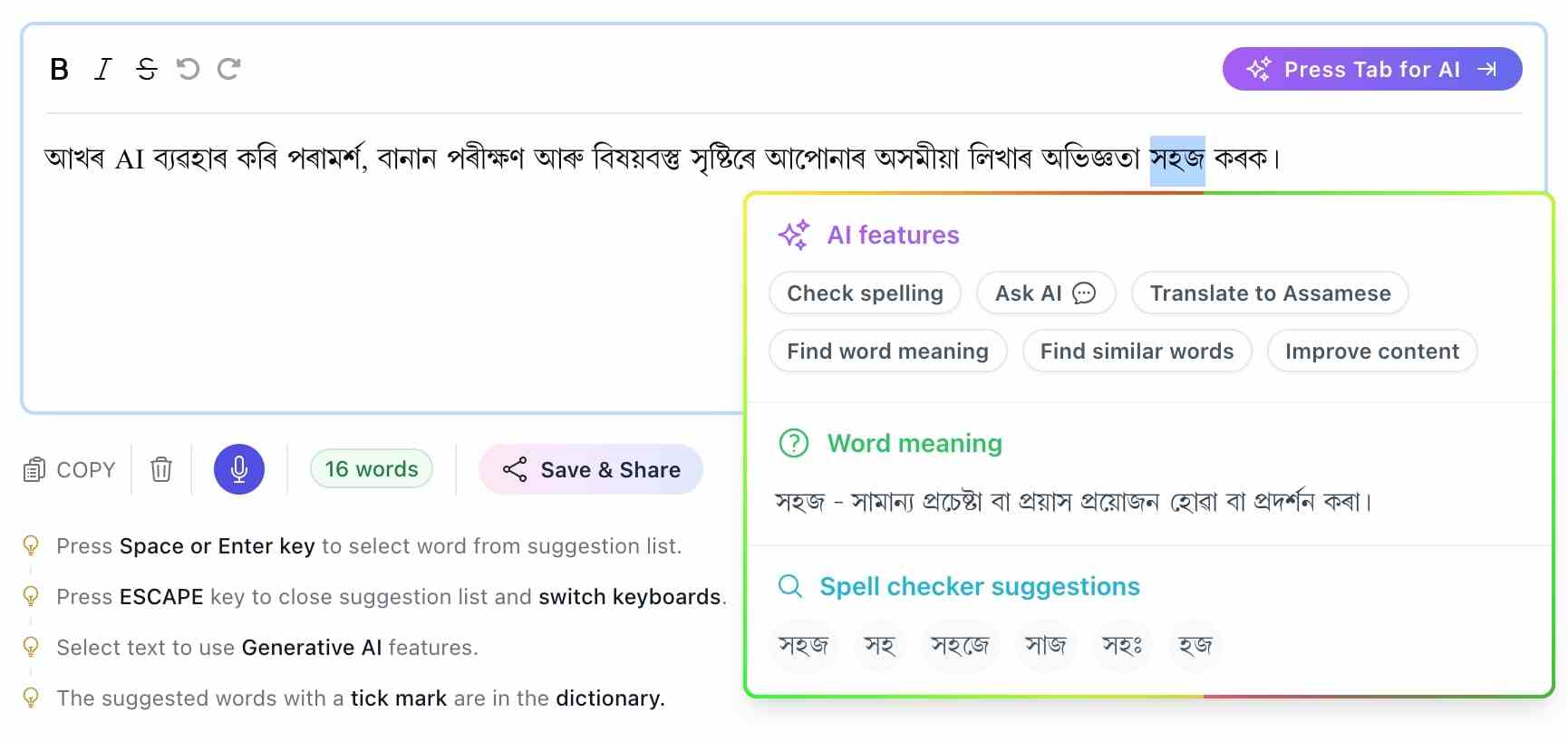
Unlock your creativity with AI-powered tools for translation, synonyms, content improvement, and more — right inside our editor.
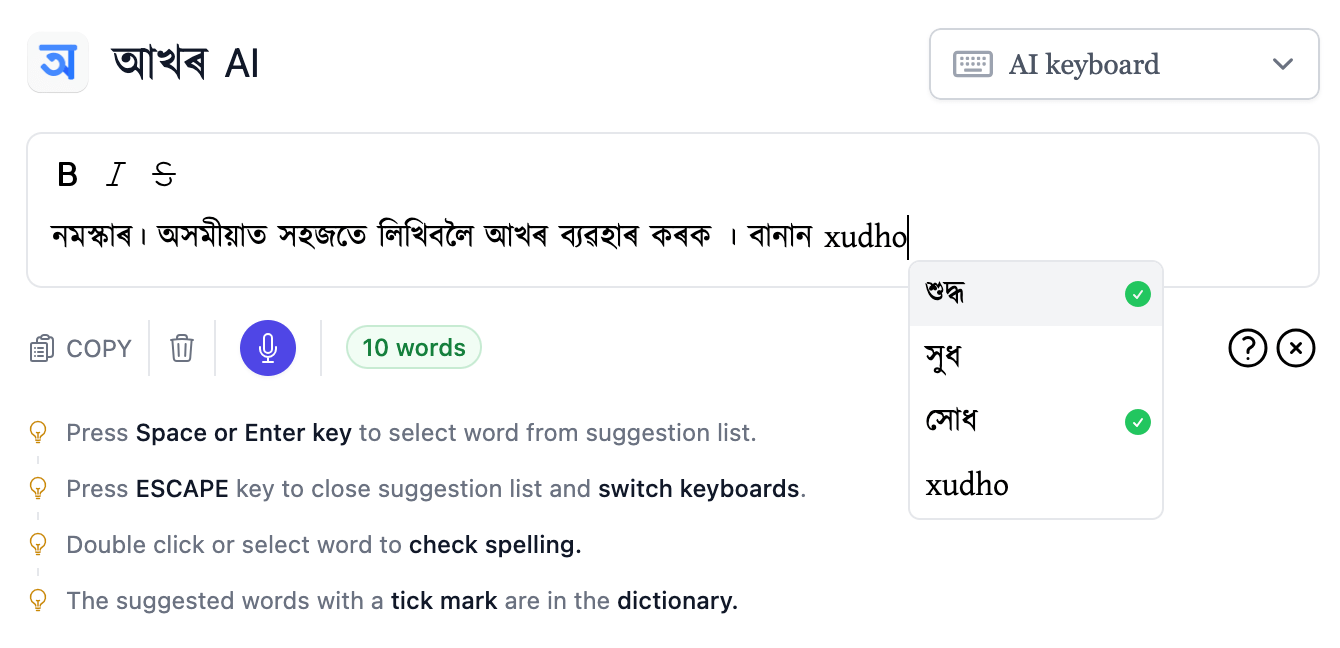
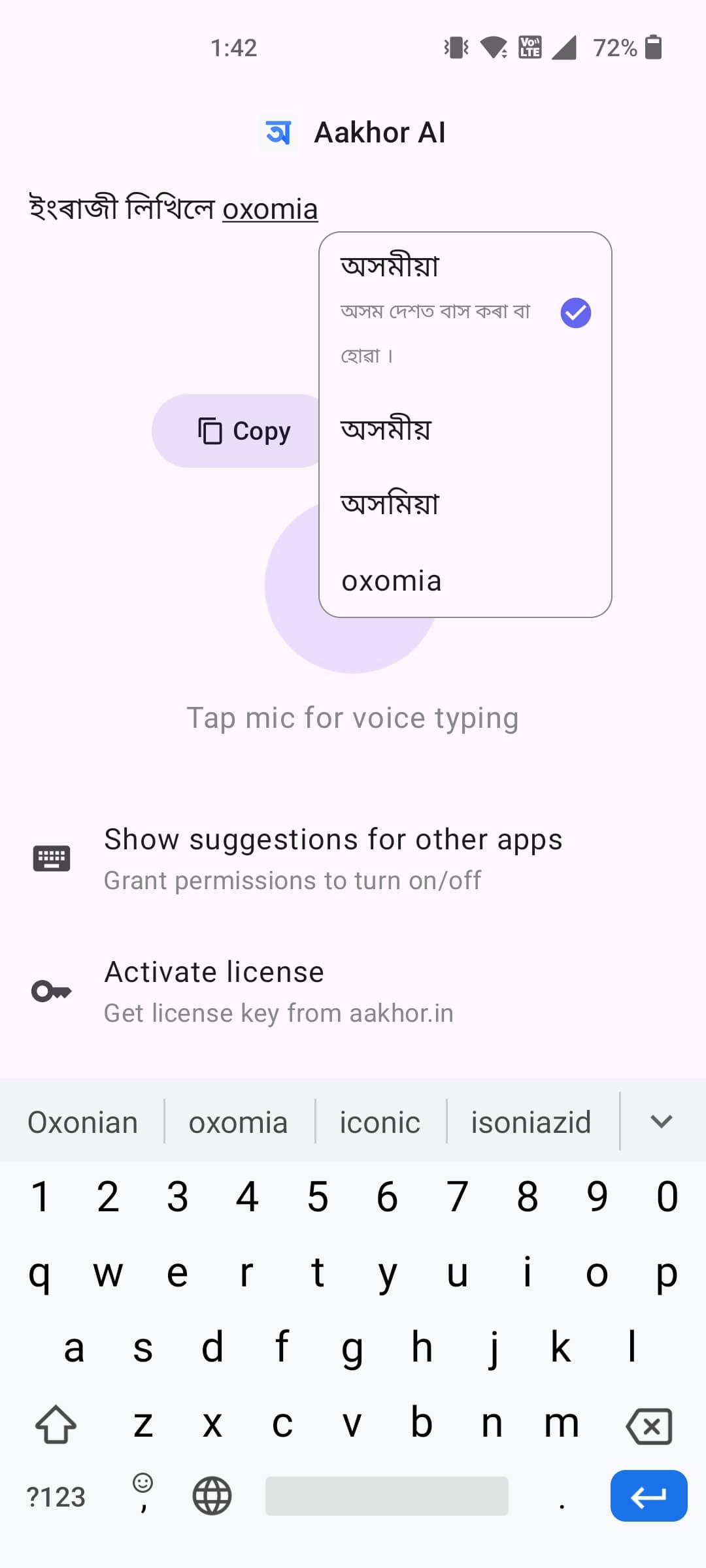
Experience the power of our AI-powered keyboard. Type Assamese faster than ever, even if you don't know the script!
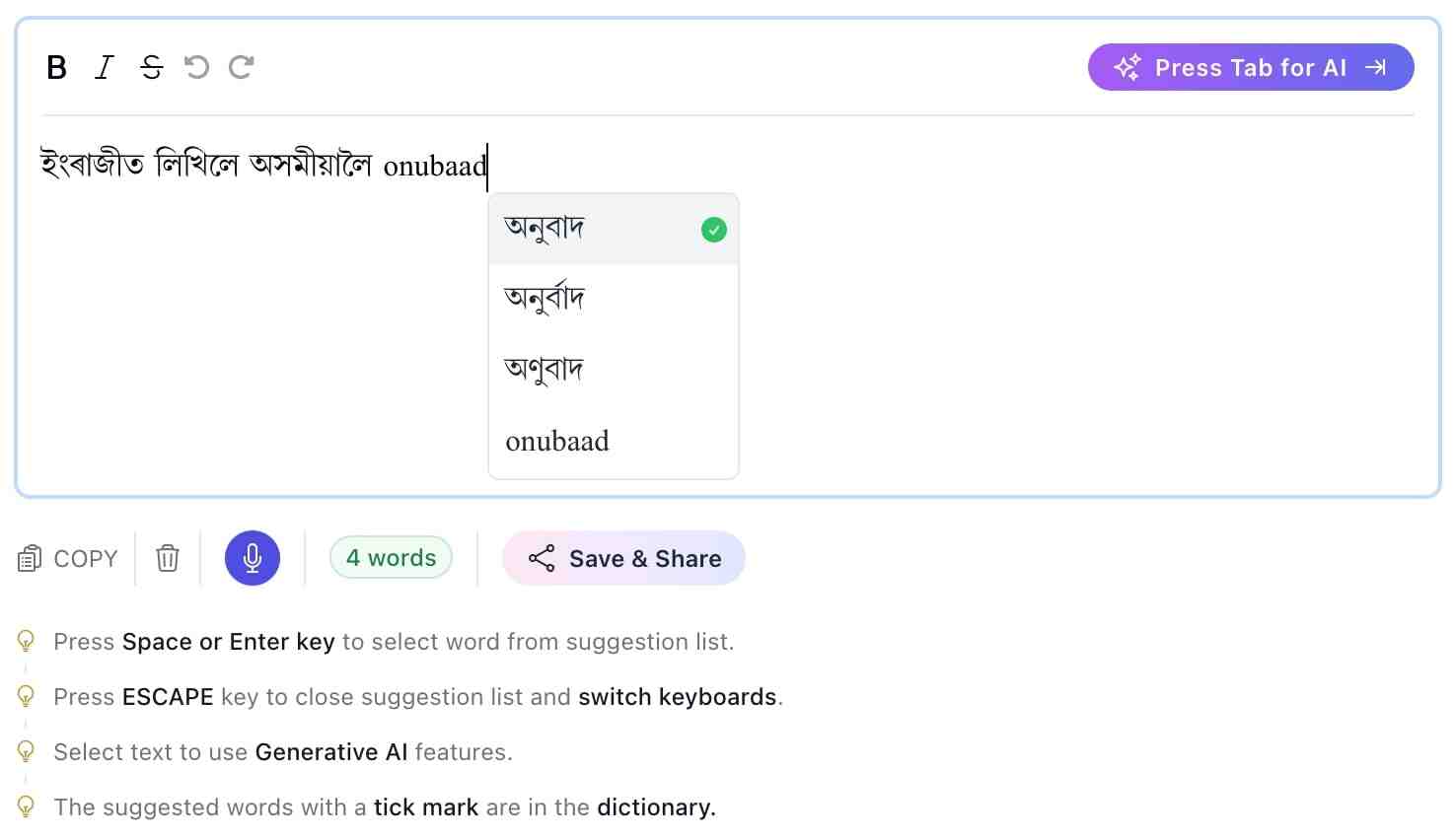
Type Assamese words using English letters and get instant Assamese result.
Get real-time spelling corrections as you type for error-free writing.
Choose from smart AI suggestions to speed up your typing and improve accuracy.
No prior experience needed. Start writing Assamese in minutes!
Type Assamese effortlessly by speaking. Our AI voice typing feature converts your speech to Assamese text in real time, making writing faster and more accessible for everyone.
Use Audiorelay mobile app to use your phone as a microphone for desktop
Boost your productivity with our all-in-one toolkit
Save important thoughts instantly and access them from anywhere.
Easily share your notes with anyone.
Find word meanings, synonyms, and usage with our smart dictionary.
Utilize the power of our tools right from your browser.
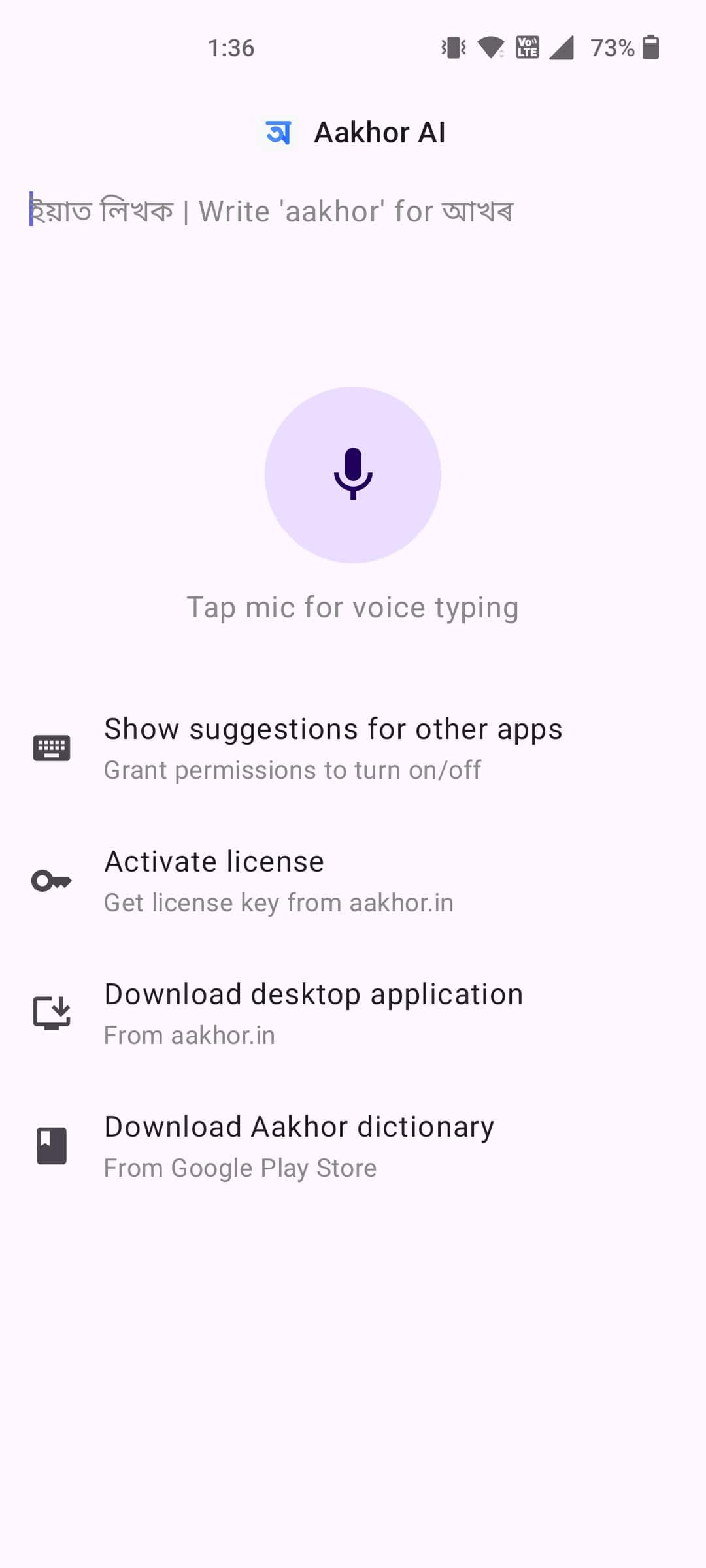
Experience seamless Assamese typing on your phone with our AI-powered mobile app. Enjoy voice typing and smart suggestions for a faster, easier writing experience.
Speak and see Assamese text appear instantly—no typing needed.
Get instant word suggestions as you type for faster, error-free writing.
The relationship between the transgender community and broader LGBTQ+ culture is not merely one of inclusion; it is one of foundational architecture. From the brick walls of Stonewall to the modern fight against healthcare discrimination, trans identities, struggles, and triumphs have repeatedly redefined what queer liberation means. Any honest discussion of modern LGBTQ+ culture must begin with the riots of June 28, 1969. The Stonewall Inn, a mafia-run bar in New York’s Greenwich Village, was a sanctuary for the most marginalized: homeless gay youth, drag queens, butch lesbians, and trans sex workers.
Similarly, gay men’s spaces (bathhouses, bars, specific dating apps) have historically been unwelcoming to trans men and non-binary people. Until very recently, many "gay" events excluded trans bodies.
Furthermore, the rise of is reshaping LGBTQ arts. No longer are the only narratives about tragedy and surgery. We are seeing a cultural explosion of trans art, music (from SOPHIE to Kim Petras), literature (from Janet Mock to Torrey Peters), and film that celebrates the pleasure of transition. Conclusion: The Rainbow Isn’t a Hierarchy To ask what the transgender community contributes to LGBTQ+ culture is to misunderstand the relationship. The trans community isn’t just a controversial letter at the end of the acronym; it is the skeleton key that unlocks the entire queer experience. hardcore shemale xxx hot
Young transgender activists are leading the charge on issues that affect everyone: prison abolition (as trans people are disproportionately incarcerated), housing rights (trans people face 40% homelessness rates), and mental health access (suicide prevention).
LGBTQ+ culture was born from a riot led by trans people. The modern "Pride" march—the cornerstone of LGBTQ culture—exists because trans women refused to stay quiet in the back of the bar. Part II: The "T" is Not Silent – Cohesion and Tension Within the LGBTQ+ Umbrella To write about the transgender community within LGBTQ culture is to acknowledge a complex, sometimes painful, marriage of necessity. The "L," "G," and "B" are primarily about sexual orientation (who you love), while the "T" is about gender identity (who you are). Historically, these groups united because they were all punished for deviating from heteronormative and cisnormative standards. The Gains of Unity The alliance has yielded incredible victories. The legalization of same-sex marriage in the US (Obergefell v. Hodges, 2015) paved the legal groundwork for transgender rights cases. Gay and lesbian media outlets (like The Advocate and later Out ) provided early platforms for trans writers. Furthermore, the medical infrastructure developed to combat the AIDS crisis—which decimated the gay male community—created activist blueprints that trans activists now use to fight for gender-affirming care. The Points of Friction Yet, the relationship is not without historical wounds. In the 1970s and 80s, some lesbian feminist groups, most notably those led by figures like Janice Raymond (author of The Transsexual Empire ), excluded trans women from women-only spaces, labeling them as infiltrators. This “trans-exclusionary radical feminist” (TERF) ideology still creates rifts in LGBTQ culture today. The Stonewall Inn, a mafia-run bar in New
Johnson famously resisted arrest by throwing a shot glass into a mirror, a moment often cited as "the shot glass heard around the world." Rivera, only 17 at the time, fought on the front lines for six nights. These women understood that gay liberation was impossible without trans liberation. However, the post-Stonewall mainstream gay movement repeatedly sidelined them. In 1973, Rivera was booed off stage at a Gay Pride rally for advocating for the rights of trans people and drag queens who were being arrested by police while cisgender (non-trans) gay men were moving into the mainstream.
LGBTQ culture today is a negotiation. Younger queers have largely rejected transphobia, pushing for inclusive language like "partner" instead of "boyfriend/girlfriend" and demanding that Pride parades center trans voices. However, the community still grapples with "drop the T" movements that argue being transgender is a different issue than being gay or lesbian. Part III: Trans Contribution to Queer Aesthetics and Language Perhaps the most visible impact of the transgender community on mainstream LGBTQ culture is linguistic and aesthetic. The Expansion of Language The transgender community gave the world vocabulary to describe nuance. Terms like non-binary , genderqueer , agender , genderfluid , and two-spirit (originating from Indigenous cultures) have infiltrated gay and lesbian discourse. A decade ago, a gay man might have only known he was "effeminate." Today, thanks to trans discourse, that same person might identify as "non-binary" or "gender-nonconforming." Trans culture taught the rest of the LGBTQ spectrum that sex and gender are not binary switches, but dials and levers. Pronouns as a Cultural Practice The practice of sharing pronouns (he/him, she/her, they/them) in email signatures, Zoom bios, and name tags is a direct export of transgender advocacy. While some cisgender (non-trans) LGB people initially mocked this as "overly woke," it has become a mainstream etiquette of queer spaces. The use of singular "they" is no longer just a grammatical curiosity; it is a signifier of cultural competency within LGBTQ circles. Redefining the Body Trans culture has also challenged the LGB community’s obsession with biological essentialism. Historically, gay male culture idolized the "Adonis" physique; lesbian culture sometimes idolized "natural" bodies. Trans people introduced the concept of bodily autonomy through modification (hormones, surgery) without shame. In doing so, they gave permission to cisgender queer people to alter their bodies (through tattoos, piercings, fitness, or steroids) for affirmation , not just aesthetics. Part IV: The Divergence of Modern Struggles While united under a rainbow banner, the political and cultural struggles of the transgender community today often diverge from those of the LGB community. Furthermore, the rise of is reshaping LGBTQ arts
The transgender community has taught LGBTQ culture the most difficult lesson of all: As long as the rainbow flag flies, that lesson will remain its most brilliant color. If you or someone you know is a transgender individual seeking community or resources, organizations like The Trevor Project, the National Center for Transgender Equality, and GLAAD offer support and advocacy networks.
Contact us for enterprise level solutions
Contact us