Installation
To install PVKII you will need 3 things.
- First: A copy of Steam
- Second: You need to have at least one legitimate Source game installed. Click Here for a full list.
- Third: You need to download a copy of the Source SDK Base which can be found in the 'Tools' tab of steam and requires a Source game to download
Finding a server
You will now need to find a server to play on. Run Pirates, Vikings and Knights II by opening the game through your 'Games' tab in Steam. Click on "Find Server" from the main menu. A menu listing all PVKII servers that have bypassed your filters will pop up. Find a server with the lowest ping that has people playing and click "Join Game".
  |
MOTD Upon
joining a server, you will see the Message Of The Day screen. Read this
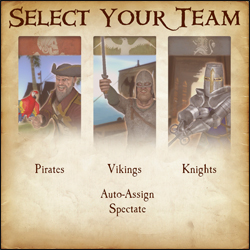
carefully, many server operators use the MOTD to explain their rules. Teams After
the MOTD screen, you will have the opportunity to select a team.
Choose to be a Pirate, Viking, or Knight. You can look at the scoreboard ('Tab' by Default) to see which team has the least number of players. You may also choose Auto-Assign if you can't decide which team to join.
Classes
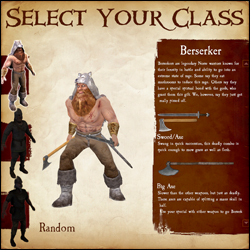
After selecting a team, you will have your choice of which class to play. As you hover over each class, a list of that class's weapons and general descriptions of each will show on the right. If you still can't decide which class to play, select random.
Kill stuff That's
its! If all has gone well, you have now spawned and are ready to do
some serious fragging. Go look for some enemies and stick a sword in 'em.
For more in-depth information on objectives, see Section 4. Game
Modes. For more information about sticking swords in people, see
Section 3. Combat. |
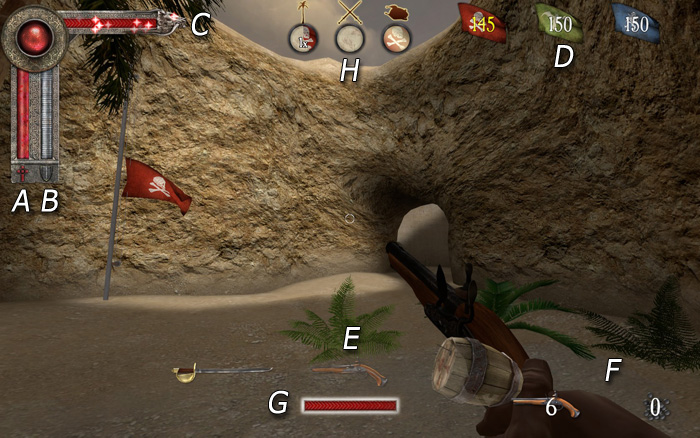
a) Health bar
b) Armor bar
c) Special attack bar
d) Round Counter
e) Weapon select
f) Ammo
G) Power Meter
H) Territory Icons
- Melee - Hold your attack button (Default Mouse1) to charge your attack, release the button to swing. Attacking with a melee weapon can be done in one of four directions. Choosing a direction to swing corresponds to your movement when first charging the attack. Moving left swings Right -> Left, moving right swings Left -> Right, forward is an Overhead chop and moving backwards is a stab. A prepared attack can be cancelled by pressing the block key (mouse2).
Hit detection now takes into account the weapon's arc. With a big enough arc (most two-handed weapons) it is possible to hit multiple opponents who are close enough together.
Hitting an opponent with a 100% charged attack will break their block and deal damage; this also has a chance of stunning them.
Try to keep your melee weapons focused on enemies, throughout the duration of your swing, to inflict maximum damage.
When two players strike each other with fully charged attacks at the same time, they will both be stunned. - Ranged - When using the throwing axes, javelins or longbow, you need to charge the weapon fully for maximum damage and distance. The javelin's charge increases by running forward. When aiming at distant targets, keep in mind the arc of the projectile and the time it will take to get there. This is especially important if your opponent is moving.
A prepared attack can be cancelled by pressing the block key (mouse2).
Projectiles fired at close range targets will do significantly less damage than if fired from further distances.
Pistols are more accurate when standing still, and the blunderbuss has a limited range due to shot spread; the closer the opponent is, the more damage it will do. - Special Attacks - Keep an eye on your special meter; it will slowly fill as you do damage to your oponents. When the meter is full, use your special by hitting your special button (Default Mouse3). Not all weapons have a special, check Section 5. Classes for more info.
b) Blocking
- Parrying - You can parry with any melee weapon (Default Mouse2) in one of four directions. The direction you block will be automatically chosen for you; this will depend on the attack direction of your closest enemy.
A successful perfect parry will mitigate all damage and stun your opponent, as well as allow you to perform a quick counter attack.
If you block to the wrong direction of your enemy's attack you will take partial damage and there is a chance you will be stunned.
Enemy weapons and shields that are glowing are fully charged and have the potential to break your block. - Shield Blocks - Shields can be used to block (Default Mouse2) both ranged and melee. While blocking, the player may hit their attack button to bash the enemy with their shield. You may also charge your shield bash as you would a normal attack. A fully charged shield bash will knock a chest from your enemy's hands. The greater the charge of your shield bash - the further enemies will be pushed back.
Shields have health points that differ for each shield. A shield that loses all of its health will break and become unusable; you can repair your shield by picking up armor.
An enemy blocking with their shield will take partial damage from a fully charged melee attack. - Counter Attacking - After a 'Perfect Parry' the player can hit their attack button to do a quick counter attack. The opponent will be stunned and unable to block.
- Weapon Sizes - The size of your weapon vs. your opponents weapon will decide how well you can parry.
Small weapons cannot 'Perfect Parry' large ones, but will reduce the damage taken when performing a successful parry.
| Last Team Standing (LTS)
The simplest game mode of them all - Kill everyone
you see who is not on your team. The last team with living players wins the round. Win the most rounds to claim overall victory! Booty (BT)
The objective of booty mode is to infiltrate the enemy bases and
bring back as many chests as you can to your own base. Every chest at
your base will lower the counter. The first team to reach zero on this
counter wins the round. On some maps, a particular team may start with
all of the chests with the objective of defending them from the other
teams who have no chests. To compensate for the advantage, the team
will have a much higher counter. In other maps there may be chests in areas of the map outside of team zones. The effective team must strike a balance
between offense and defense, for if everyone is on offense, an enemy
may steal chests from the base while no one is there. Should everyone
be concentrated on defense, there is no possibility of obtaining more
chests. Capturing a chest that was previously owned by another team will remove 5 tickets from your counter and add 5 to theirs. First team to hit 0 tickets wins. Standing in an enemy's chest zone will stall their tickets from decreasing. Use your special while carrying a chest to gain a speed boost for a few seconds. Territory (TE)
Territory is exactly as the name says. The objective is to capture and hold the territories throughout the map. Once a territory is captured, it will count down that team's tickets. The more territories your team holds, the faster your counter goes down. In some maps, holding all of the territories at once will initiate a final countdown; if your team holds all of the territories for the duration of that countdown, you win automatically. Otherwise, the first team to reach 0 wins the game. Standing in an enemy territory, even when outnumbered, will slow the rate that their tickets will decline. Standing in a territory you control will prevent an equal or lesser number of enemies from neutralizing it. It's impossible to capture a neutral territory without first clearing out all the enemies inside. Objective Push
This is an interesting game mode as it will change depending on the map. Mappers have free reign to make anything an objective as long as it has an input/output ability. The designated team that defends must hold out until the timer hits zero, the designated attackers must complete the objectives before the timer reaches zero. If you're a mapper, check here for a quick guide.
Trinket Wars (TW)
In Trinket Wars, each team gets its own ancient relic to protect. The objective is to score kills on enemy players whilst holding your teams trinket or being near your team's trinket carrier. Once you've collectively scored enough points to satisfy the level's ticket requirement, you win! Teamwork is very heavily emphasized in this mode. Only losers fly solo!
|
Rijal Al Kashi Report 176 Hot- Now
“I entered upon one of the companions. He was not from the elite scholars, but a devoted follower. I found him in a gathering where poetry was being recited—not erotic or satirical verses, but heroic and elegiac poetry (hamasa and marathi). With him were his family members and some neighbors. They were listening to a singer (qayna) who was not a professional courtesan, but a trusted domestic servant. The melody was light, and they were drinking a non-intoxicating beverage (nabidh – non-fermented fruit drink). When I expressed surprise, he said: ‘The Messenger of Allah (PBUH) said: To cheer your heart, to seek beauty, and to enjoy permissible leisure is part of the completion of faith. Do not make religion burdensome.’” Immediately following this anecdote, al-Kashi (or al-Tusi) inserts a rijal analysis: the narrator in question is considered mamduh (praiseworthy) and not rejected for this behavior. Part 3: The Lifestyle Dimensions of Report 176 What does Report 176 reveal about lifestyle? It shatters several modern stereotypes about early Islamic piety. 1. The Home as a Social Hub The report indicates that private homes were not austere prayer cells. They were vibrant spaces for communal listening, aesthetic enjoyment, and emotional release. The presence of family members and neighbors suggests a collective lifestyle where entertainment was a shared, bonding activity—not a solitary or shameful secret. 2. The Role of Permissible Aesthetics The detail of “seeking beauty” ( talab al-jamal ) is critical. Early Imami culture recognized that human beings require visual and auditory beauty. The report implies that monotony and extreme austerity were considered psychologically unhealthy. Thus, cultivating a beautiful environment (through clean clothes, pleasant scents, and tasteful decor) was part of the sunnah . 3. Work-Life Balance in Classical Islam The companion in Report 176 was not a wealthy aristocrat. He was a working-class believer. His entertainment—listening to poetry and mild melodies—was low-cost, home-based, and scheduled. It did not interfere with prayers or professional duties. This suggests a deliberate model of integrated piety : worship, work, and leisure coexisting without contradiction. Part 4: Entertainment – What Was Allowed and What Was Avoided? Perhaps the most debated aspect of Report 176 is its treatment of music and singing. In modern Islamic discourse, music is a polarizing topic. However, classical sources like Rijal al-Kashi offer a more nuanced picture. A. The Qayna (Singing Girl) Distinction The report explicitly mentions a qayna who is “not a professional courtesan.” In 9th-century Kufa and Baghdad, many qaynat were enslaved singers trained in the courtly arts, often associated with wine-drinking and licentious behavior. However, Report 176 distinguishes a domestic, trusted singer whose role was purely artistic. This echoes the ahadith permitting the duff (frame drum) and huda (caravan songs) on Eid days. B. Poetry as Moral Reinforcement The poetry in question was hamasa (heroic epics about the Prophet’s battles and Imam Ali’s chivalry) and marathi (elegies for martyrs like Imam Husayn). Entertainment, therefore, was not vacuous. It served a higher purpose: strengthening communal identity, commemorating sacrifice, and cultivating courage. This is the antithesis of time-wasting; it is edutainment for the soul. C. The Nabidh Debate The mention of nabidh (non-intoxicating fruit drink) is often misunderstood. Shi’a fiqh (following the Ahl al-Bayt) strictly forbids any amount of muskir (intoxicant). The report specifies a non-fermented beverage—essentially a sweet fruit juice or raisin infusion. This aligns with numerous narrations where Imams drank chilled nabidh on hot days as refreshment. Entertainment, in this context, included sensory pleasure (taste and temperature) without violating divine law. Part 5: Psychological and Social Functions of Entertainment in Report 176 Why did al-Kashi include such a report in a book of narrator criticism? Because the lifestyle of a narrator directly impacted his reliability. A. Preventing Extremism (Ghuluw) The early Imami community faced a threat from ghulat (extremists) who abandoned all worldly pleasure, claiming that piety required monasticism. Report 176 serves as a corrective. The Imam’s circle (implicitly endorsing this companion’s behavior) rejected ascetic extremism. A balanced lifestyle that includes halal entertainment is a sign of sound ‘aql (intellect), not spiritual deficiency. B. Social Cohesion in a Minority Context The Shia of Kufa, Qom, and Baghdad were a persecuted minority. Constant fear and grief (especially after the tragedy of Karbala) could lead to collective depression. Report 176 demonstrates that the Imams permitted—indeed encouraged—permissible leisure as a psychological coping mechanism . Listening to heroic poetry restored dignity. Light music in the home reduced anxiety. Communal gatherings broke isolation. C. Distinguishing Between Weakness and Humanity Al-Kashi’s verdict in Report 176 is crucial: the narrator is not weakened because he enjoys permissible entertainment. This sets a major principle in ‘Ilm al-Rijal . A narrator does not need to be an austere desert hermit to be thiqah (trustworthy). He can laugh, enjoy melodies, and seek beauty—as long as he avoids haram (sin). Thus, the report humanizes the rijal figures, rescuing them from the one-dimensional caricature of the “pious robot.” Part 6: Modern Applications – What Report 176 Teaches Us Today For contemporary Muslims, especially those in the West, the keyword “Rijal Al Kashi Report 176 - lifestyle and entertainment” is a search that often arises from a crisis of identity. Young believers ask: Can I enjoy video games? Movies? Concerts of nasheed or martial arts films?
For the modern Muslim drowning in secular entertainment on one side and extremist religious rigidity on the other, Report 176 offers a middle path: the way. Rijal Al Kashi Report 176 HOT-
Unlike later rijal works that focused purely on memorization capacity and moral uprightness in a vacuum, al-Kashi’s approach was socio-contextual. He often quoted conversations, letters, and anecdotes that revealed the character of a narrator in public and private spheres. falls squarely into this category. It is not merely a verdict; it is a narrative. Part 2: Decoding Report 176 – The Text and Its Immediate Context While the exact numbering may vary slightly between manuscripts and digital databases (e.g., in software like Jawami' al-Kalim or Dar al-Hadith ), Report 176 typically centers on a narrator from the circle of Imam Ja'far al-Sadiq (AS) or Imam Musa al-Kadhim (AS). The report is transmitted through a chain leading to a companion who describes a surprising scene. “I entered upon one of the companions
This article will deconstruct Rijal al-Kashi Report 176 , moving beyond the binary of "trustworthy" ( thiqah ) versus "weak" ( da'if ). We will explore what this report tells us about how early Muslims navigated leisure, social bonding, permissible entertainment, and the psychological pressures of being a minority faith community. Before diving into Report 176, it is crucial to understand the nature of the source. Abu Amr Muhammad ibn Umar al-Kashi (d. circa 941 CE) was an Imami scholar from Kesh (modern-day Shahrisabz, Uzbekistan). His original work, Kitab al-Rijal , was later abridged and corrected by Shaykh Abu Ja'far al-Tusi (d. 1067 CE), who titled it Ikhtiyar Ma'rifat al-Rijal . With him were his family members and some neighbors
However, buried within the dense biographical entries and technical critiques lies a fascinating subtext. Among the most intriguing of these is . At first glance, it appears to be another standard entry on a narrator’s reliability. But a deeper, more holistic reading reveals something unexpected: a rare window into the lifestyle and entertainment of the early Shia community in the 8th and 9th centuries CE.
The answer, drawn from this remarkable report, is profoundly liberating. Early Imami piety was not grim-faced withdrawal from the world. It was an integrated, beautiful, and balanced existence. The companion in Report 176—laughing with neighbors, listening to heroic verses, sipping a sweet drink under soft melodies—was deemed praiseworthy because his entertainment did not lead to sin; it led to gratitude, community, and emotional resilience.
In the vast ocean of classical Islamic scholarship, few texts have commanded as much reverence and scrutiny as Rijal al-Kashi (also known as Ikhtiyar Ma'rifat al-Rijal ). This seminal work, meticulously curated by Shaykh al-Tusi from the earlier compilations of Abu Amr al-Kashi, serves as a cornerstone of ‘Ilm al-Rijal (the science of narrators). For centuries, scholars have pored over its entries to authenticate the chains of transmission ( asanid ) that preserve the traditions of the Ahl al-Bayt.
Players
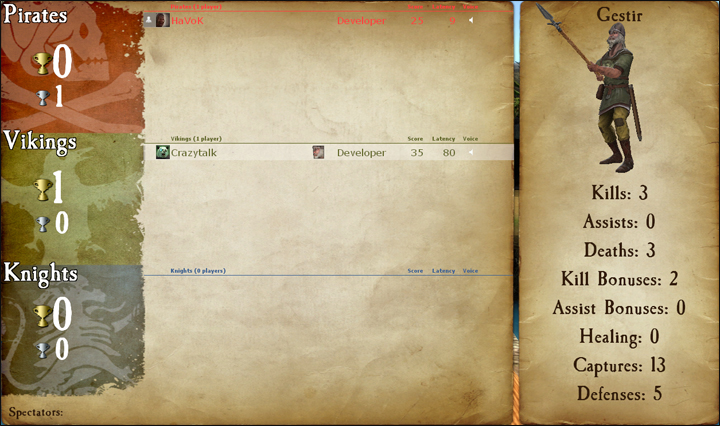
The first icon represents the player's avatar; if that player is a steam friend of yours they will also have a friend icon attached to their avatar.
Next to the avatar is the player's steam name.
The icon next in line is that player's class icon. Check the scoreboard to see which classes are already being played on your team.
Next to the player's icon is a section for showing when a player has died. This section may also have a tag under it for Developers, Testers, Admins, Contributors and Donators. Server admins can also set sv_communitygroup to the ID of a specific group; that group's title will show up for any players in that group, as long as the title does not conflict with the tags previously mentioned.
The section to the right of here is reserved for Score and Latency, as well as a speaker icon that shows when a player is using their mic. Click on the speaker icon to mute a player's microphone and text chat.
Score Breakdown
- Kills - The number of enemies whom you have killed.
- Assists - Your kill assists. You get an assist any time you were the last to damage a player within a few seconds of a teammate killing them.
- Death - The number of deaths you've suffered. (Good thing it's just a game!)
- Kill Bonuses - You get kill bonuses from things like getting revenge in last team standing, grail kills, etc.
- Assist Bonuses - Just like kill bonuses, but when you get the assist.
- Healing - Points you get from healing your teammates. Not currently used.
- Captures - You gain capture points from completing objectives. This includes capturing a chest, capturing a territory, etc.
- Defenses - The number of times you've defended an objective. This could be returning a stolen chest, defending a territory, etc.
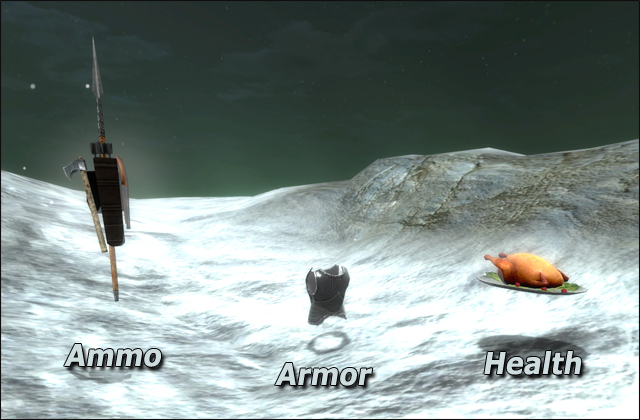
Armor/Ammo